Newsroom
Why Do Precision Equipment Prefer Crossed Roller Bearings?
As industries such as robotics, semiconductor manufacturing, medical systems, and automation continue to advance, precision equipment increasingly requires compact structures, high rigidity, and accurate rotational performance.
To meet these demands, many engineers are turning to crossed roller bearings as a preferred solution for high-precision rotary systems.
What Is a Crossed Roller Bearing?
A crossed roller bearing is designed with cylindrical rollers arranged alternately at 90° between the inner and outer rings.
This unique structure allows a single bearing to simultaneously support:
- Radial loads
- Axial loads
- Moment loads
Compared with conventional bearing arrangements, crossed roller bearings provide higher rigidity and rotational accuracy within a compact design.
Why Are They Ideal for Precision Equipment?
High Rigidity
Precision equipment often operates under strict positioning requirements. Even small deformation can affect machining accuracy or system stability.
Because crossed roller bearings use line contact between rollers and raceways, they offer significantly higher rigidity compared with standard ball bearings.
This helps maintain stable performance under complex loading conditions.
Excellent Rotational Accuracy
Crossed roller bearings are widely used in applications requiring smooth and accurate rotation.
Proper preload can further reduce:
- Internal clearance
- Vibration
- Rotational runout
As a result, positioning accuracy and repeatability are greatly improved.
Compact Structure
Space-saving design is critical in modern equipment such as robots, medical devices, and semiconductor machinery.
Crossed roller bearings can support multiple load directions with a single bearing, helping engineers reduce system size and simplify structural design.
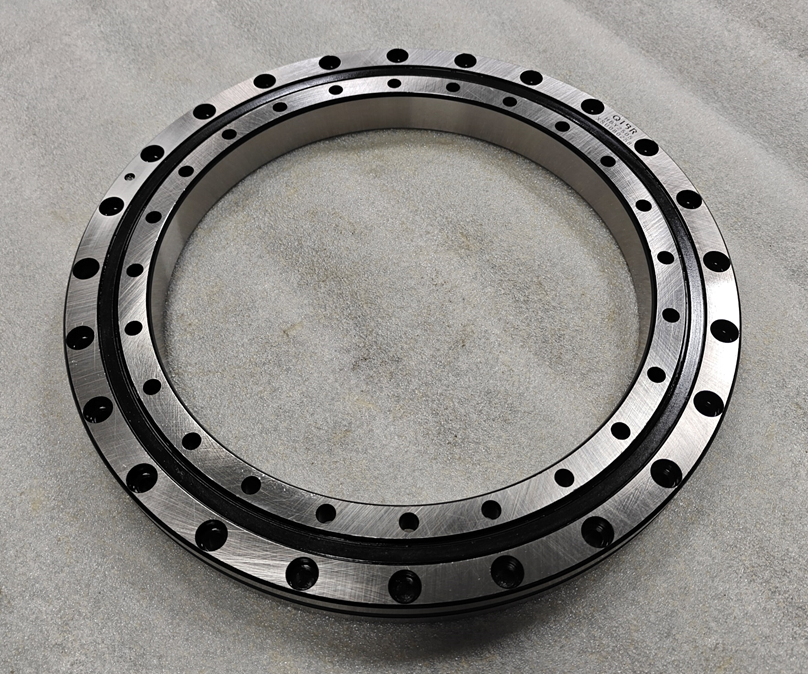
Models such as XSU 080258, RU series, and CRBH series are commonly selected for compact precision systems.
Ability to Support Complex Loads
Unlike standard radial bearings, crossed roller bearings are capable of handling:
- Radial force
- Axial force
- Tilting moment
This makes them ideal for applications involving robotic arms, rotary tables, and positioning platforms.
Typical Applications
Due to their performance advantages, crossed roller bearings are widely used in:
- Industrial robots
- Harmonic drive systems
- Rotary indexing tables
- Medical imaging equipment
- Semiconductor equipment
- Optical positioning systems
In these industries, both rigidity and rotational precision are essential.
Crossed Roller Bearings vs Conventional Bearings
Compared with traditional bearing arrangements, crossed roller bearings offer:
- Higher rigidity
- Better rotational accuracy
- More compact structure
- Simplified installation
These advantages make them increasingly popular in next-generation precision machinery.
Conclusion
As precision equipment continues moving toward higher accuracy, compactness, and automation, crossed roller bearings are becoming an increasingly important component in modern mechanical systems.
Their combination of rigidity, precision, and multi-directional load capability makes them an ideal solution for demanding rotary applications.