Newsroom
What Is the Difference Between Thin Section Deep Groove Ball Bearings and Thin Section Angular Contact Ball Bearings?
Thin section bearings are widely used in robotics, medical equipment, semiconductor machinery, aerospace systems, and other applications where space and weight are critical design factors. Among the various types available, Thin Section Deep Groove Ball Bearings and Thin Section Angular Contact Ball Bearings are two of the most commonly used options.
Although they share a similar compact profile, their internal designs and load-carrying capabilities differ significantly. Understanding these differences can help engineers select the most suitable bearing for their applications.
What Are Thin Section Bearings?
Thin section bearings are designed with a constant cross-section regardless of bore diameter. This unique design allows engineers to reduce weight and save installation space while maintaining performance and reliability.
Common thin section bearing structures include:
- Thin Section Deep Groove Ball Bearings
- Thin Section Angular Contact Ball Bearings
- Thin Section Four-Point Contact Ball Bearings
Each type is designed to meet different operating requirements.
Thin Section Deep Groove Ball Bearings
Thin section deep groove ball bearings feature a simple raceway design that allows them to support primarily radial loads, along with moderate axial loads in both directions. 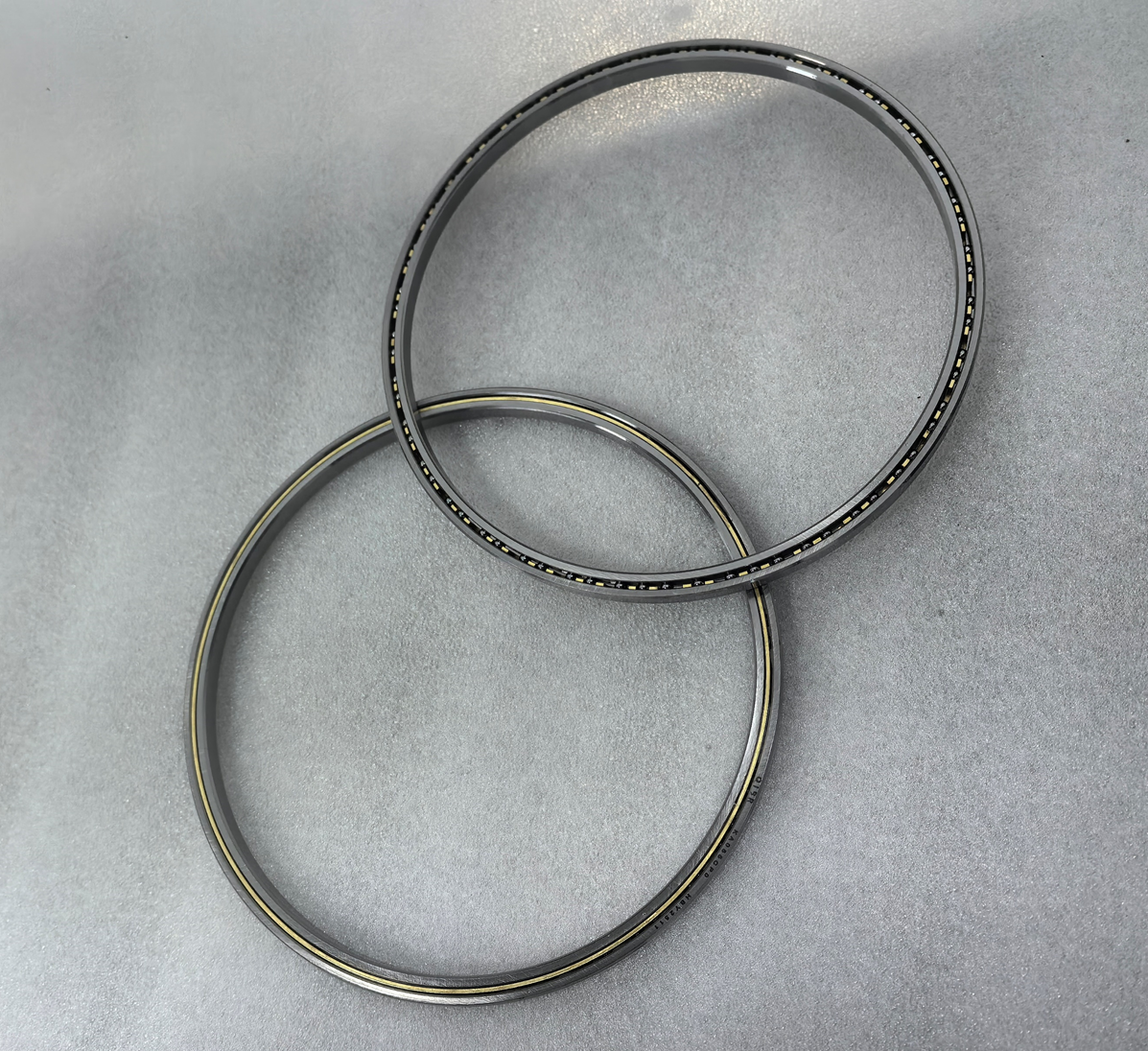
Key Advantages
- Low friction and smooth operation
- High-speed capability
- Cost-effective solution
- Easy installation and maintenance
Typical Applications
- Electric motors
- Automation equipment
- Medical devices
- Optical instruments
- Lightweight rotating systems
For applications where radial loads dominate and operating speeds are relatively high, thin section deep groove ball bearings are often the preferred choice.
Thin Section Angular Contact Ball Bearings
Thin section angular contact ball bearings are designed with a contact angle between the balls and raceways, enabling them to carry combined radial and axial loads more effectively. 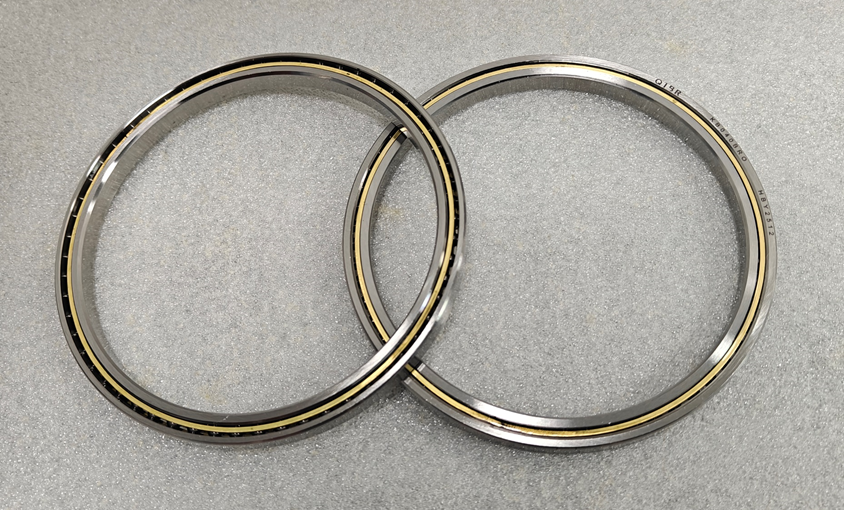
Key Advantages
- Higher axial load capacity
- Better rigidity and positioning accuracy
- Suitable for preload arrangements
- Improved performance in precision systems
Typical Applications
- Robotic joints
- Precision positioning equipment
- Machine tool components
- Semiconductor equipment
- Aerospace systems
Where accuracy, stiffness, and axial load capacity are critical, angular contact bearings often provide superior performance.
Key Differences at a Glance
| Feature | Thin Section Deep Groove Ball Bearing | Thin Section Angular Contact Ball Bearing |
|---|---|---|
| Primary Load | Radial Load | Combined Radial and Axial Load |
| Axial Load Capacity | Moderate | High |
| Rigidity | Standard | Higher |
| Precision Applications | Good | Excellent |
| Preload Capability | Limited | Excellent |
| High-Speed Performance | Excellent | Excellent |
| Typical Series | C Type | A/B Type |
Which Bearing Should You Choose?
The selection depends on your application's operating conditions.
Choose a Thin Section Deep Groove Ball Bearing when:
- Radial loads are dominant
- High-speed operation is required
- Cost and simplicity are important
Choose a Thin Section Angular Contact Ball Bearing when:
- Significant axial loads are present
- Higher rigidity is required
- Positioning accuracy is critical
- Preload arrangements are needed
Conclusion
While both bearing types offer the space-saving advantages of thin section bearings, they are designed for different performance requirements.
Thin Section Deep Groove Ball Bearings excel in high-speed, low-friction applications, while Thin Section Angular Contact Ball Bearings provide greater rigidity and axial load capacity for precision equipment.
Understanding these differences can help optimize equipment performance, extend service life, and improve overall system reliability.