Newsroom
Design, Performance, and Industrial Applications of Tapered Roller Bearing 518-974
Tapered roller bearings are indispensable components in heavy-duty machinery, renowned for their ability to simultaneously withstand large radial and axial loads. Among these, the 518-974 model stands out as a large-size special tapered roller bearing, engineered to deliver exceptional reliability and load capacity in extreme industrial environments. This article provides an in-depth analysis of its structural design, core parameters, performance advantages, applications, and maintenance considerations, highlighting its critical role in modern heavy industry.
1. Fundamental Structure and Working Principle
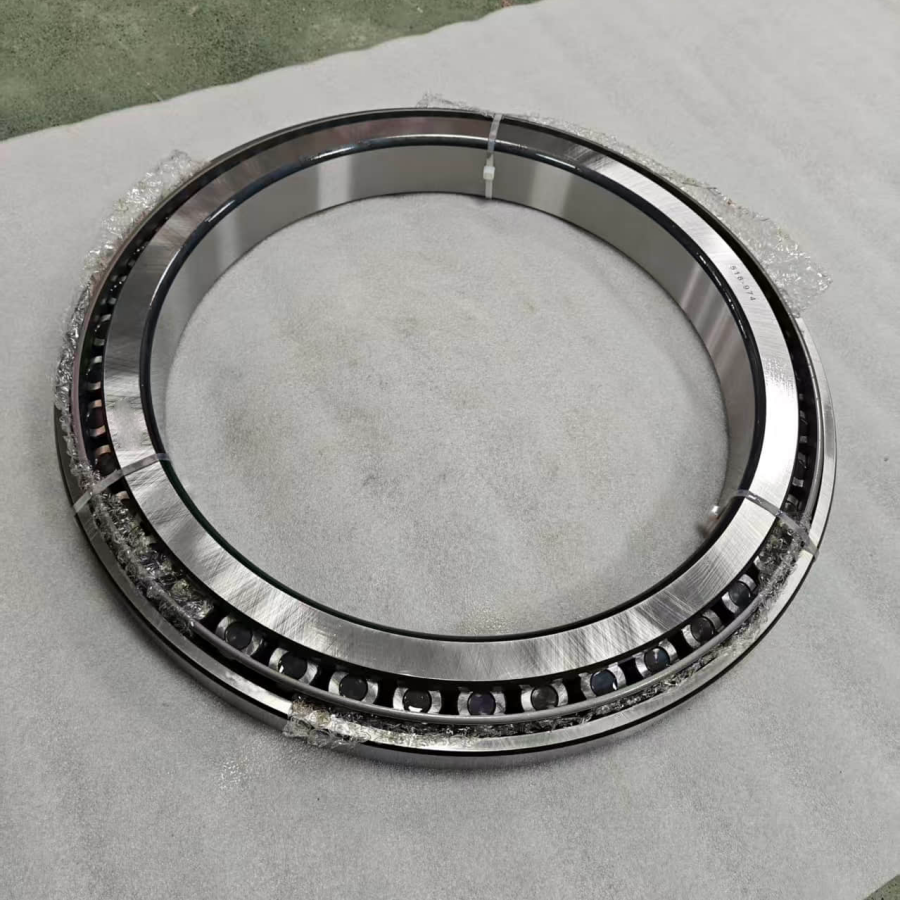
The 518-974 bearing adheres to the classic design of tapered roller bearings, consisting of four core components: an inner ring (cone), an outer ring (cup), tapered rollers, and a precision cage. A defining feature is the conical geometry of both the raceways and rollers—when extended, the conical surfaces of the inner ring, outer ring, and rollers converge at a single common point on the bearing’s central axis. This geometric precision eliminates sliding friction between the rollers and raceways, ensuring pure rolling motion and minimal energy loss during operation.
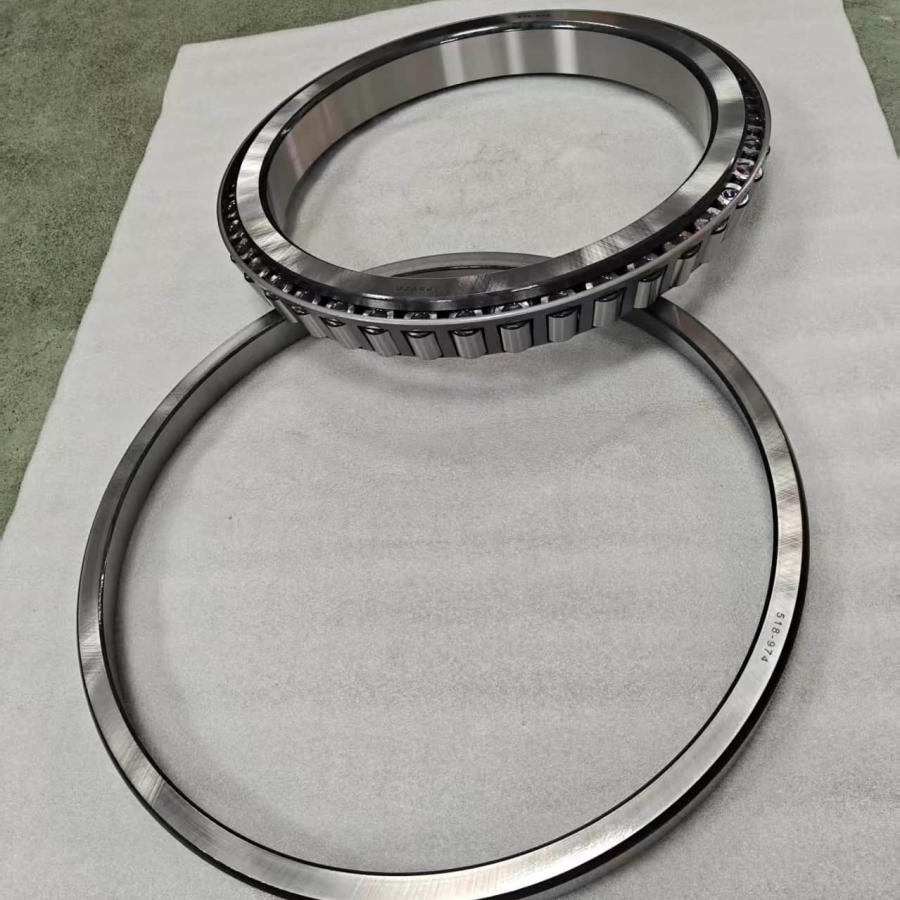
As a separable bearing, the inner ring assembly (including rollers and cage) can be completely separated from the outer ring, simplifying installation, inspection, and maintenance. The cage, typically made of high-strength stamped steel or alloy, maintains uniform spacing between rollers, preventing contact and reducing friction, vibration, and wear. This structural design enables the 518-974 bearing to efficiently distribute combined radial (perpendicular to the shaft) and axial (along the shaft) loads, a capability far superior to ball bearings, which rely on point contact and thus have lower load limits.
2. Key Technical Specifications
The 518-974 is classified as a large-bore heavy-duty tapered roller bearing, with dimensions and load ratings tailored for high-load scenarios. Its critical parameters are as follows:
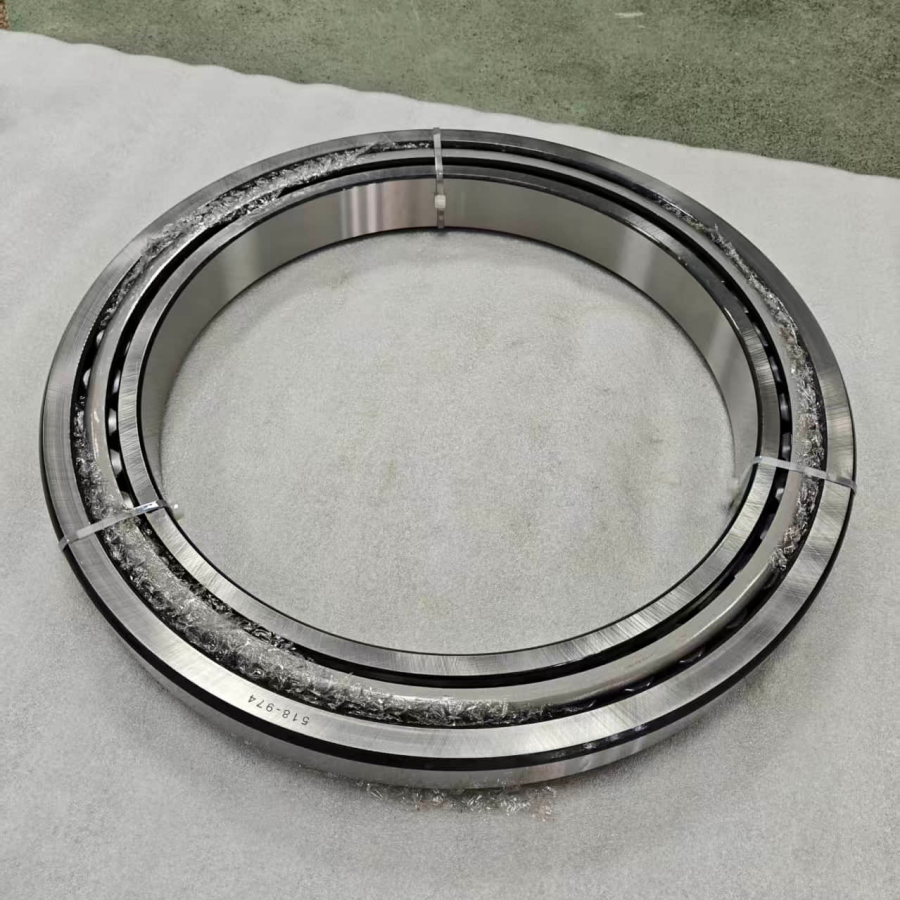
Dimensions: Inner diameter (d) 381 mm, outer diameter (D) 498.5 mm, total width (T) 54 mm. This large bore size accommodates thick, high-torque shafts used in heavy machinery.
Load Capacity: Dynamic load rating (Cr) 715 kN, static load rating (Cor) 1590 kN, fatigue limit load (Cu) 17.2 kN. The extremely high static load rating allows it to support heavy stationary or slow-moving loads without permanent deformation.
Weight: 26.1 kg, a robust build that balances structural rigidity and manageable installation for large bearings.
These specifications position the 518-974 as a high-performance component for applications requiring exceptional load-bearing capacity and durability.
3. Core Performance Advantages
The 518-974 bearing integrates material science and precision engineering to deliver outstanding performance in harsh conditions, with three key advantages:
3.1 Superior Combined Load Resistance
Unlike cylindrical roller bearings (which primarily handle radial loads) or thrust bearings (limited to axial loads), the 518-974 excels at simultaneous heavy radial and axial load support. Its optimized taper angle balances radial and axial load distribution—larger contact areas from line contact reduce surface stress, enabling it to withstand shock loads and vibration common in mining, metallurgy, and construction equipment.
3.2 Exceptional Durability and Fatigue Life
Constructed from high-grade chrome alloy steel, the bearing undergoes precision heat treatment (carburizing and quenching) to achieve high surface hardness (HRC 60–64) and core toughness. This resists wear, pitting, and fatigue failure—critical for bearings operating 24/7 in abrasive or high-temperature environments. The 518-974’s fatigue limit load of 17.2 kN ensures long-term reliability even under cyclic heavy loads.
3.3 High Rigidity and Dimensional Stability
Large-size bearings risk deformation under extreme loads, but the 518-974’s thick-walled rings and reinforced cage provide exceptional rigidity. Precision machining ensures tight dimensional tolerances, maintaining accurate shaft alignment and minimizing runout. This stability is vital for high-precision heavy machinery, where misalignment can cause catastrophic failure.
4. Industrial Applications
The 518-974’s robust design and high load capacity make it ideal for heavy-duty industrial applications where reliability under extreme conditions is non-negotiable. Key sectors include:
4.1 Mining and Mineral Processing
In mining equipment such as crushers, conveyors, and rotary drills, the 518-974 supports heavy shafts under abrasive dust, high vibration, and shock loads. Its resistance to wear and fatigue ensures continuous operation in harsh underground or open-pit environments, reducing unplanned downtime.
4.2 Metallurgy and Steel Production
Steel mills rely on the 518-974 for rolling mills, continuous casters, and furnace conveyors. These applications involve high temperatures, heavy rolling loads, and constant operation—conditions that demand the bearing’s high-temperature resistance and load capacity.
4.3 Heavy Construction and Engineering
Large construction machinery, including excavators, cranes, and bulldozers, uses the 518-974 in axles, gearboxes, and swing mechanisms. Its ability to handle combined radial and axial loads ensures stability during heavy lifting, digging, and travel on rough terrain.
4.4 Heavy-Duty Transportation
In heavy trucks, trailers, and railway locomotives, the 518-974 is used in wheel hubs and drive axles. It supports high vehicle weights and torsional loads, providing reliable performance over long distances and in varying road conditions.
5. Installation and Maintenance Considerations
To maximize the 518-974’s service life, proper installation and maintenance are critical:
Installation: As a separable bearing, the inner ring assembly and outer ring must be installed separately with precise alignment. Avoid hammering directly on the rings—use hydraulic presses or specialized tools to prevent damage. Correct axial and radial clearance adjustment is essential to avoid overheating or premature wear.
Lubrication: Use high-temperature, extreme-pressure (EP) grease or oil suitable for heavy loads. Regular lubrication (per manufacturer schedules) reduces friction and prevents metal-to-metal contact. In high-temperature environments, synthetic lubricants are recommended.
Inspection: Periodically check for wear, pitting, or discoloration (signs of overheating). Monitor vibration and noise—abnormalities indicate potential issues. Seal integrity is critical to prevent contamination from dust, water, or debris, which can accelerate wear.
6. Conclusion
The 518-974 tapered roller bearing is a masterpiece of heavy-duty bearing engineering, combining robust design, exceptional load capacity, and outstanding durability. Its unique conical geometry, high-grade materials, and precision manufacturing enable it to thrive in the most demanding industrial environments, from mining and metallurgy to construction and transportation.
As heavy industry evolves, the demand for reliable, high-performance bearings will only grow. The 518-974 stands as a testament to the critical role of tapered roller bearings in modern machinery—supporting progress, ensuring efficiency, and powering the heavy industry that drives global economic development. When properly installed and maintained, the 518-974 delivers long-term, trouble-free operation, making it an indispensable component for heavy-duty applications worldwide.